From Victorian homes to European-inspired landmarks, much of Glenwood’s history is written not on paper, but in stone and brick. Take a closer look at the architecture of one of Colorado’s favorite mountain towns.
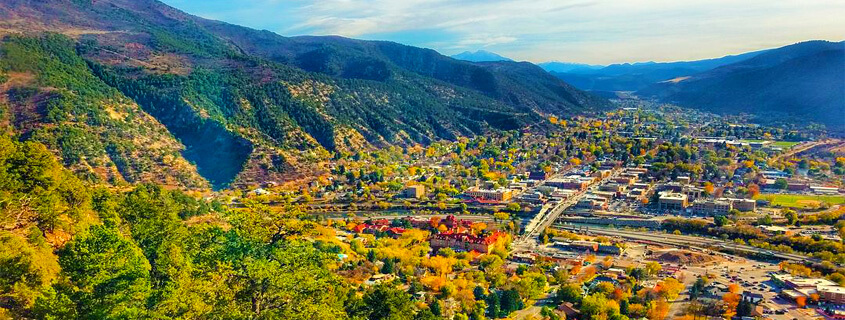
Glenwood Springs is a Colorado vacation destination renowned for its hot springs and outdoor adventures, but another story is hiding in plain sight. It’s written in brick and stone, expressed through turrets, porches, grand hotels and Western-inspired water towers.
Glenwood’s buildings are more than structures, they’re the backstory of our town’s history. They tell the tale of a place that grew from a rough-and-tumble tent outpost once named Defiance into a fashionable and genteel resort destination, and ultimately into a locale that embraces its love of authentic mountain living.
As Glenwood matured from a makeshift outpost of rag-tag tents and rough-hewn cabins, it borrowed architectural ideas from Europe and the East Coast, putting its own Colorado stamp on them along the way.
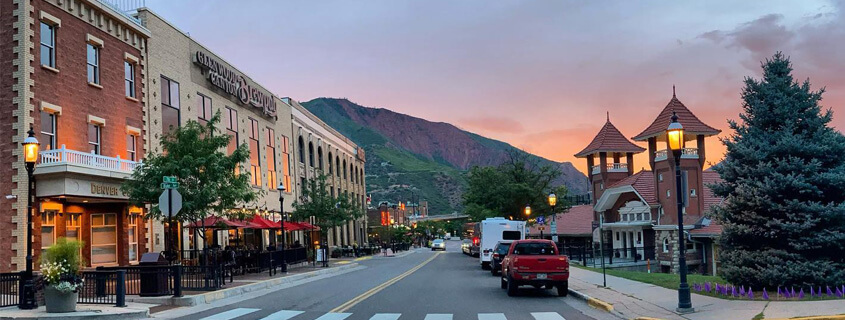
Exploring today, you’ll find more than a century of Glenwood Springs history built right into the streetscape.
Victorian Glenwood
By the late 1800s, Glenwood Springs was growing up fast. The railroad had arrived, visitors were coming to “take the waters,” and a once-rowdy Western town was starting to settle down.
The homes and commercial buildings constructed during this period reflected an optimistic worldview with an eye toward elegance, refinement, and stability.
“Victorian” actually encompasses a number of architectural styles, but you don’t need to know a Queen Anne from an Eastlake Stick to appreciate them. Just look for the telltale signs: steep rooflines, gables, decorative woodwork, colorful paint touches, wrap-around porches and plenty of elaborate details.
These styles are rampant throughout Glenwood Springs, but two outstanding examples of Victorian style are the landmarked homes at 830 Blake Ave. and Starr Manor at 901 Palmer Ave.
A Little Bit of Italy and a Whole Lot of Colorado
 Spanning both sides of the Colorado River, Glenwood’s historic hot springs district includes Hotel Colorado and Glenwood Hot Springs on the north side and the historic Train Depot on the south. A quick glance reveals a common aesthetic that runs through all three.
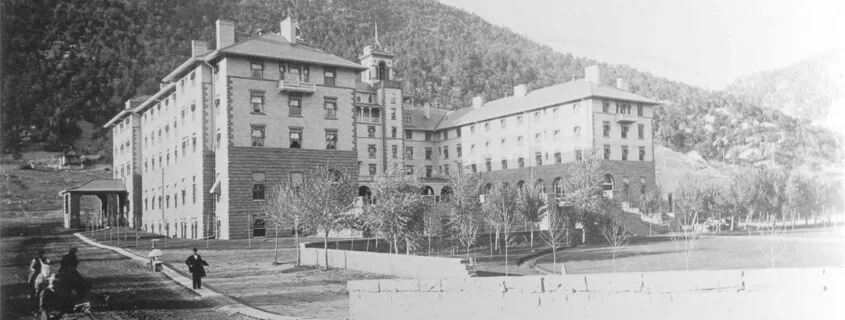
Walter Devereux, an early Glenwood Springs visionary, dreamed of creating a resort with a hotel and pool equal in beauty and stature to the finest in Europe.
He hired New York architects Boring, Tilton & Mellon to design the Hotel Colorado in the Italian Renaissance style, drawing inspiration from the palatial Villa Medici in Rome. Later he chose Theodore von Rosenberg to design the hot springs Bathhouse, now Hotel 1888, in the Romanesque Revival style, characterized by rounded arches and a formidable castle-like presence. The train depot, last to be built, is also attributed to von Rosenberg.
Despite their different architectural influences, the buildings share an unmistakable family resemblance thanks to the distinctive stone used in all three. The pinkish-red stone was quarried at Wilson’s Peachblow Quarry on the Upper Frying Pan River near Basalt and transported to Glenwood Springs via the Colorado Midland Railroad.
New Century, New Look
The turn of the 20th century brought changing tastes to Glenwood Springs. No longer a fledgling frontier settlement, the town was keeping pace with architectural trends sweeping the country.
Colonial Revival favored symmetry, classical details and a more orderly appearance than many of its Victorian predecessors. The 1901 Shelton-Holloway House on Fifth Street offers a distinctive Dutch Colonial Revival variation, complete with an easy-to-spot gambrel, or barn-like, roof. At 931 Cooper Ave., the First Church of Christ incorporates Colonial Revival elements, including prominent symmetrical columns.
Other buildings mixed architectural influences. The 1904 Edward T. Taylor House on Bennett Avenue combines the sturdy, boxy form of an American Foursquare with Colonial Revival details.
Downtown, the Citizens National Bank Building draws on Classical Revival architecture, projecting a solid sense of permanence and prosperity.
By the early 1900s, Glenwood Springs had arrived—not just as a Western town, but as an established Western Colorado community embracing the architectural fashions of a new century.
From Opera House to Art Deco
 If there’s one building that proves architecture is entertaining, it might be Durand’s Opera House at 312 Seventh St.
Built in 1888 as a stove and hardware store, it was converted into an opera house by the early 1890s. John Philip Sousa and his band performed there in 1901, and the building later became the Odeon Theater and dance hall. In 1926, Western movie star Tom Mix—who was in Glenwood Springs filming The Great K & A Train Robbery—even sponsored a prize fight there.
Its present Art Deco-style brick façade likely dates to around the same period, giving the frontier-era building a decidedly Jazz Age vibe. Today it is the home of KC’s Winghouse, part of Glenwood’s Restaurant Row, and continues to host live entertainment and dancing.
The West Lives On
Of course, Glenwood Springs never completely left the Wild West behind.
Its architectural backstory continues at some of its newest attractions. Glenwood Caverns Adventure Park and Iron Mountain Hot Springs deliberately borrow from the visual archives of the West with timber, mining-inspired details, rustic materials—and even water towers!
They aren’t remnants of Glenwood’s frontier days. They’re modern interpretations of them, using architecture to connect today’s visitor experience with the town’s Western past.
As disparate as the styles may seem, together, they tell the story of Glenwood Springs—one building at a time. For a guided stroll through Glenwood’s architecture and history, visit the history and culture link on the interactive map at VisitGlenwood.com/base-map. Otherwise, learn more and make plans to visit Glenwood Springs today!